
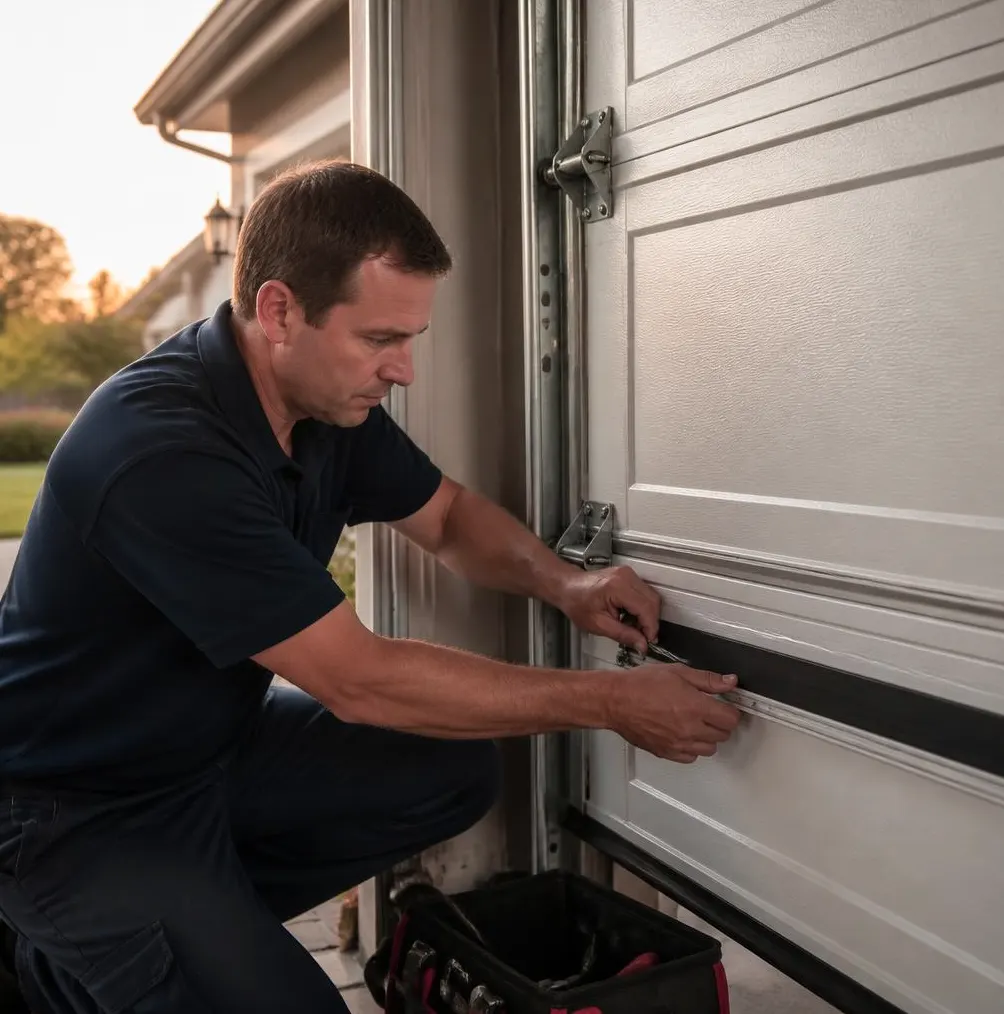
Wait until the first real windstorm of the season to think about your garage door, and you're choosing between two bad outcomes: a door that gets pushed in or ripped off its track in the middle of the night, or a cracked torsion spring that leaves the door stuck wide open while snow blows straight into the garage. Either one turns into an emergency call, a damaged vehicle or stored belongings, and in the worst case, a door failure that lets wind pressure into the house itself. A few hours of inspection now is cheaper than any of that.
Why the Garage Door Is the Weakest Point in the Wall
Every other exterior wall in a house is a solid, continuous structure. The garage door is not. It's a large panel of hinged, rolling sections held in place by springs, tracks, rollers, and a motor — not by framing. When wind hits the front of a house, that pressure has to go somewhere. If the garage door flexes, bows, or blows in, the sudden pressure change inside the garage can push upward on the roof structure from underneath, which is why building codes in high-wind regions increasingly call out garage doors specifically. A door that's marginal on a calm day can become the point of failure during a real wind event.
What This Region's Weather Actually Does to a Door
Woodland Park and the rest of the Pikes Peak region don't get hurricane winds, but they get something a door can still lose to: sustained downslope wind events off the mountain, combined with big day-to-night temperature swings and dry air that keeps hardware moving constantly through expansion and contraction. A few specific effects worth knowing:
- Cold snaps steel springs. Torsion springs lose some flexibility in freezing temperatures, and a spring that's already near the end of its cycle life is far more likely to snap on a cold morning than a mild one.
- Daily swings loosen hardware. Metal tracks and brackets expand and contract every single day here, not just seasonally. Over time this works bolts loose and nudges tracks slightly out of alignment — small misalignments that get worse under wind load.
- Dry air dries out seals. Rubber weatherstripping and bottom seals harden and crack faster in dry, high-altitude conditions, leaving gaps that let wind-driven snow push into the garage.
The Pre-Winter Inspection Checklist
You don't need to be a technician to catch most of the warning signs. Walk through this before the first hard freeze:
- Run the balance test. Disconnect the opener, lift the door halfway by hand, and let go. A properly balanced door stays put. If it drifts up or slams down, the springs are compensating poorly and are under more stress than they should be.
- Check the tracks for daylight gaps. Look along both vertical tracks for spots where the rollers aren't seated evenly. Even a slight gap means the door isn't tracking true, which concentrates stress on one side during wind gusts.
- Inspect rollers and hinges. Cracked, flat-spotted, or visibly worn rollers should be replaced before winter, not after they fail on a subzero morning.
- Tighten all visible hardware. Track brackets, hinge bolts, and the opener rail mount all loosen gradually. A quarter-turn with a wrench on each one takes ten minutes and removes a lot of slack that wind can exploit.
- Replace cracked or flattened weatherstripping. Both the bottom seal and the side/top weatherstripping should still have some flex to them. If they're stiff or cracking, they won't seal against wind-driven snow.
- Test the opener's force settings and battery backup. Winter storms here mean power outages. A battery backup lets you open and close the door manually or electronically when the power's out, which matters if you need to get a vehicle out during a storm.
Springs Are the One Thing Not to Gamble On
Torsion springs are rated for a certain number of open-close cycles, typically somewhere in the 10,000-cycle range for standard residential springs, translating to roughly seven to twelve years of normal use. If yours is original to an older house, or you've noticed the opener straining, the door feels heavy when lifted by hand, or there's visible gap or rust on the spring coils, don't wait for a cold morning to find out it's done. A spring that lets go under load — especially with wind pushing against the panel at the same time — is one of the more dangerous and more disruptive failures a garage door can have.
When Reinforcement Makes Sense
For older doors, especially lighter aluminum or thin steel panels without internal bracing, a reinforcement kit (horizontal struts bolted to the inside of each panel) adds meaningful wind resistance without replacing the whole door. For a door that's already showing its age — warped panels, worn-out track, an opener that's been struggling for years — it's often more practical to replace it outright with a door built for this region's wind and temperature swings rather than keep patching an older one.
When to Call Woodland Park Garage Door Specialists
If your door fails the balance test, you're hearing new noises, or a spring looks worn or has visible gaps in the coil, that's worth a call before winter sets in rather than after a storm. We handle Spring Replacement with correctly matched, properly wound springs rated for the cycle life and load your door needs, and our Preventive Maintenance visits cover the full inspection above — track alignment, hardware torque, weatherstripping, roller condition, and opener force and battery checks — so nothing gets missed. For doors that are past the point of reinforcement, we can also talk through installation options built for this climate.
If you're in Woodland Park, Divide, Florissant, Green Mountain Falls, Manitou Springs, Cascade, Cripple Creek, or Victor and want your garage door checked before the next wind event or cold snap rolls through, give Woodland Park Garage Door Specialists a call. We show up on time, do the inspection properly, and fix what actually needs fixing — nothing more.