
The Moment You Notice Something's Wrong
You hit the button on your way out, or on your way to bed once the Teller County cold has settled in for the night. The door starts down, drops a foot or two, then stops and climbs right back up to open. Or maybe it doesn't move at all — you push the button and the opener light just blinks at you, over and over, like it's trying to tell you something in Morse code. Either way, you're standing in the driveway in the cold, pulling out your phone to look it up.
Both symptoms usually trace back to the same handful of culprits, and most garage door technicians check them in roughly the same order, starting with the cheapest and easiest fix first.
Start With the Safety Sensors
The two small eyes mounted a few inches off the floor on either side of the door track are the single most common reason a door reverses before it closes, or won't close at all. If they're misaligned, dirty, or one is staring into direct light, the opener assumes something's in the doorway and refuses to finish the cycle — even if the garage is completely empty.
This is especially worth checking in late fall. The sun sits lower on the horizon this time of year, and at certain times of day it can shine almost straight through a garage door opening and wash out a sensor's signal. Spiderwebs, dust, and the occasional bump from a snow shovel or bike handlebar can also throw the eyes out of alignment.
The fix: Wipe both lenses with a soft, dry cloth. Check that the small LED light on each sensor is steady, not flickering — a flickering light usually means misalignment. Loosen the wing nut, nudge the sensor gently until both lights go solid, and retighten. This takes five minutes and solves the problem more often than anything else on this list.
Check the Sensor Wiring
If the lenses are clean and aligned but the lights still flicker, follow the wire back from each sensor. Mice looking for a warm place to spend the winter will chew through low-voltage wiring, and a wire pinched under a staple or corroded from moisture can send an intermittent signal that mimics an obstruction. A damaged wire needs to be re-run or spliced — patching it with electrical tape is a short-term fix at best.
Look at the Opener's Close-Force and Limit Settings
Every opener has a setting that tells it how much resistance is normal before it decides something is blocking the door. If that force is set too sensitive, a door that's slightly heavier than usual — common once cold, dry air stiffens the hardware — can trip the safety reverse even with nothing in the way.
The fix: Most openers have a small dial or a menu accessed through the learn button where you can adjust the down-force and travel limits. This needs to be done carefully and tested a few cycles at a time; too much force defeats the safety feature it's there for.
Inspect the Tracks for Obstructions
Next on the list is the track itself. Ice buildup, frozen debris, or a bent section from a stray bumper tap can all cause the door to bind partway through its travel, which the opener reads as an obstruction. A gap that's barely noticeable in summer can widen or shift as temperatures swing between a sunny afternoon and a well-below-freezing night, exactly the kind of day-to-night swing this area gets regularly.
The fix: Run a hand along both tracks (door closed, power to the opener disconnected) feeling for ice, debris, or a section that's pulled away from the wall. Minor bends can sometimes be coaxed back into alignment; a track that's badly kinked needs to be replaced.
Rollers and Hinges Working Against the Door
Nylon rollers get brittle in cold, dry air and can crack or flat-spot, making the door's travel rough instead of smooth. A door that judders or hangs up on one side as it travels is putting uneven strain on the opener, and the opener may reverse rather than force it through.
The fix: Replace cracked or worn rollers, tighten loose hinges, and lubricate moving parts with a silicone-based garage door lubricant — not an all-purpose spray, which thins out too fast in this climate and leaves the hardware dry again within weeks.
Springs Carrying More Than They Should
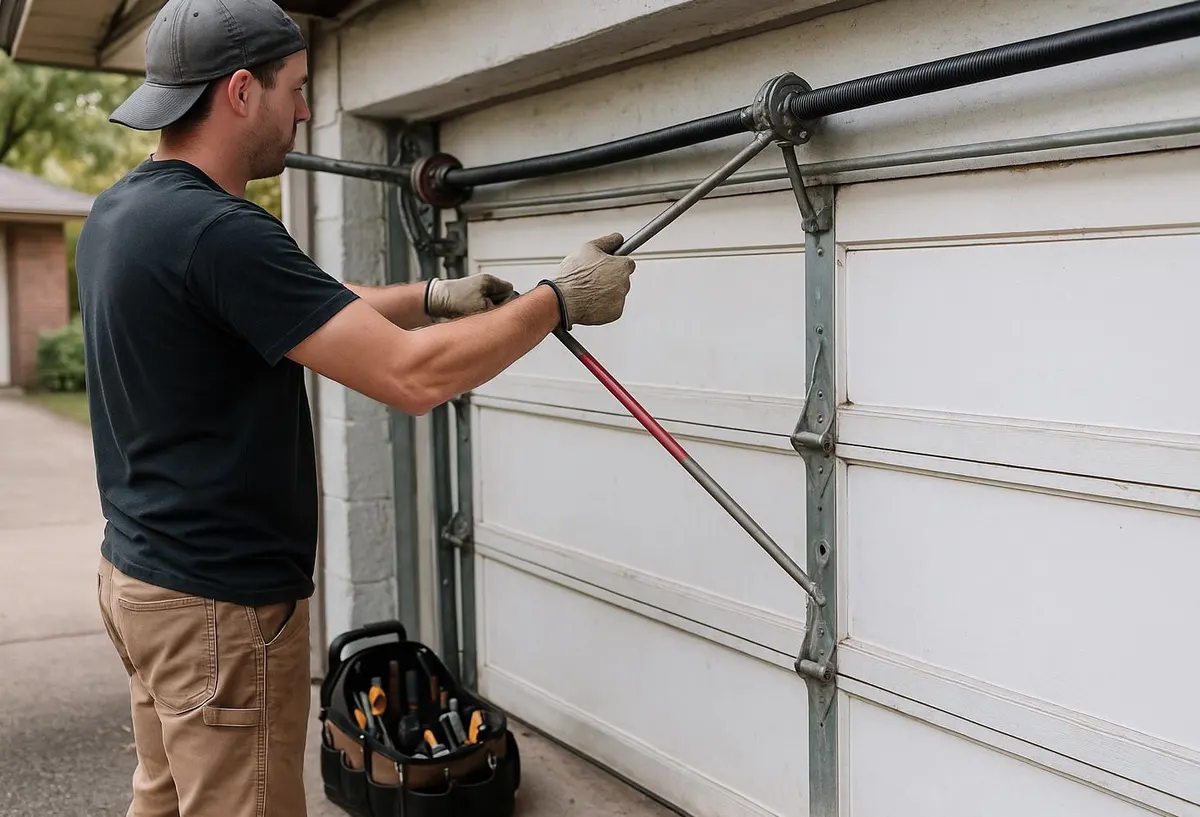
If everything above checks out and the door still struggles, strains, or reverses under load, the torsion spring may be losing tension. A weakened spring means the opener is doing more of the lifting than it was built to do, and it will often read that extra strain as an obstruction. This is also one of the more dangerous DIY fixes on the list — torsion springs are under serious tension and should be left to someone with the right tools and experience.
When It's the Opener Itself
If none of the above resolves it, the issue may be inside the opener — an aging logic board, a worn drive gear, or a motor that's simply tired after years of cycling through Woodland Park winters. At that point, repair or replacement of the unit is usually the more cost-effective path than chasing symptoms.
When to Call Woodland Park Garage Door Specialists
If you've checked the sensors and they're clean and aligned, and the door still won't close or keeps reversing, it's time to bring in a technician rather than keep guessing. We'll run through opener force settings, track alignment, and spring tension with the right tools to pinpoint the exact cause — often as part of our Garage Door Opener Service or, if the spring is the culprit, a straightforward Spring Replacement. Either way, you get a door that closes the first time, every time, instead of one you have to coax shut in the cold.
If your garage door is giving you trouble this week, give Woodland Park Garage Door Specialists a call. We serve Woodland Park, Divide, Florissant, Green Mountain Falls, Manitou Springs, Cascade, Cripple Creek, and Victor, and we'll get your door working right before winter settles in for good.